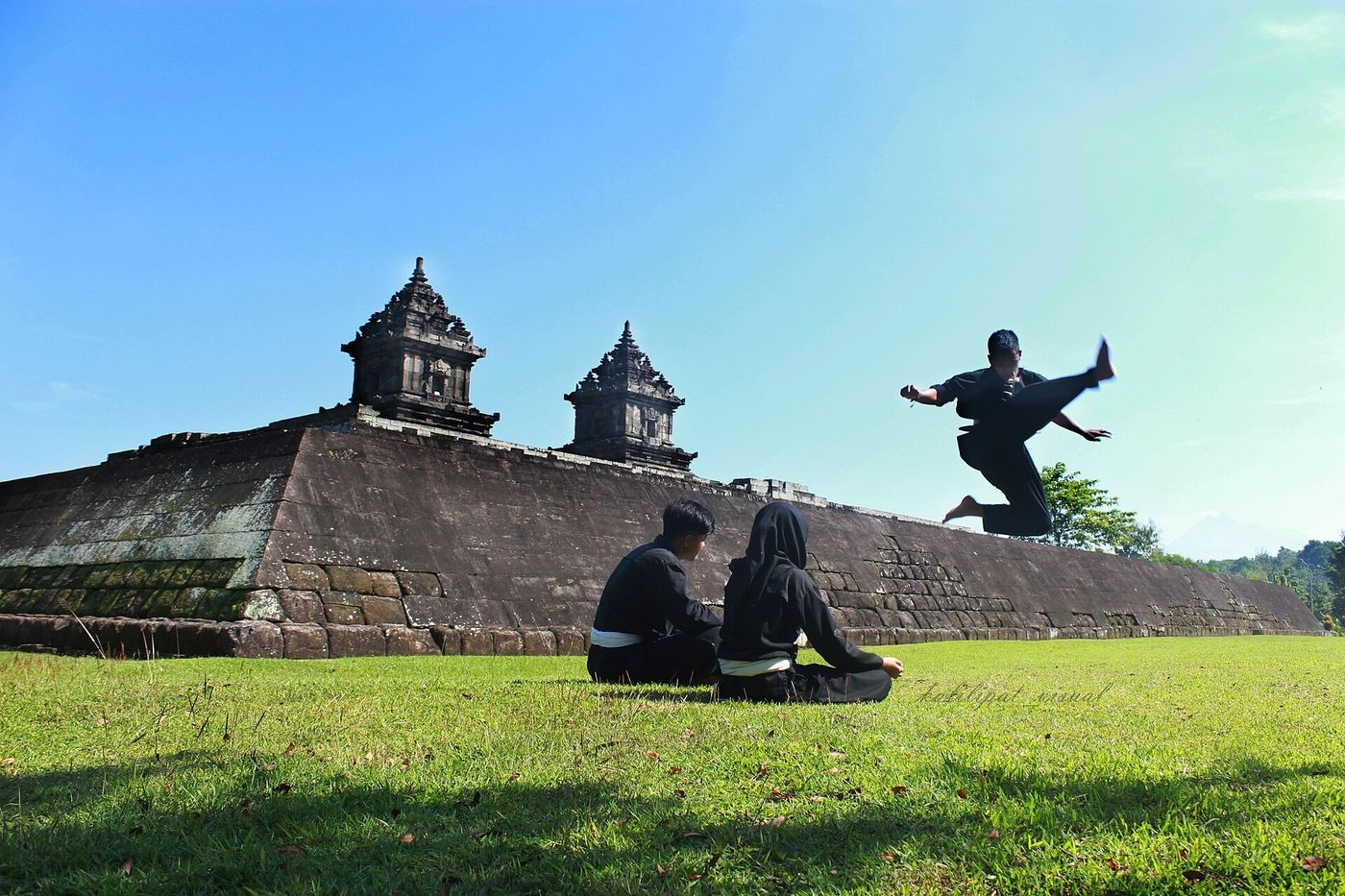
Overview
Pencak silat is a family of fighting arts from the Malay archipelago. UNESCO describes it as a group of related martial arts, with each region keeping its own moves, music, costumes and weapons. There are hundreds of schools (perguruan) in Indonesia and Malaysia.
The practitioner, or pesilat, fights standing but close to the ground. Stances are low, footwork follows set patterns (pola langkah) and sequences are learnt as jurus, forms comparable to karate kata. Empty hands and weapons are taught side by side: the same movement can strike, deflect a blade or trap a stick.
Four strands sit together: mental and spiritual training, self-defence, the art form (seni), often performed to drums and gongs, and competitive sport. Schools weight these differently, so classes can vary a great deal from one club to the next.
In France, pencak silat is one of the disciplines delegated to the Fédération française de karaté et disciplines associées (FFKDA), the French karate federation, alongside kali eskrima in its South-East Asian martial arts group.
History
Fighting techniques in the archipelago were handed down orally, from teacher to pupil, in villages and schools. Early movements often copied animals such as the tiger or the eagle, and each region developed its own style: silek in West Sumatra, cimande and cikalong in western Java, gayong in Malaysia.
Dutch colonial authorities restricted the practice, which carried on in secret. It revived during the Japanese occupation and spread widely after Indonesian independence. On 18 May 1948 the IPSI (Ikatan Pencak Silat Indonesia) was founded in Surakarta, Central Java, to bring the country's schools together. That is when the two words were joined in the official name 'pencak silat'.
The international federation, PERSILAT (Persekutuan Pencak Silat Antarbangsa), was set up in Jakarta on 11 March 1980 by the federations of Indonesia, Malaysia and Singapore, together with Brunei. Pencak silat joined the Southeast Asian Games in 1987 in Jakarta and has stayed on the programme. It made its Asian Games debut in 2018 in Jakarta and Palembang, where Indonesia won 14 of the 16 titles.
In December 2019, in Bogotá, the UNESCO committee inscribed two separate files on its Representative List of the Intangible Cultural Heritage: the 'traditions of pencak silat', nominated by Indonesia, and 'silat', nominated by Malaysia. The double listing reflects a practice shared across borders.
Techniques
Punches, palm strikes and elbows combine with front, roundhouse and spinning kicks, often thrown from a low stance. Knees come in at close range. An attack is rarely thrown on its own: it flows into a grab or a break of balance.
The signature of pencak silat is putting the opponent down. Sweeps, reaps and leg scissors (guntingan), where the pesilat traps the opponent's legs between their own to topple them, are drilled from the first lessons. Joint locks and throws complete the toolkit.
Weapons are part of the basic syllabus. The golok, a type of machete, and the parang are the standard blades; the kerambit, a small claw-shaped curved blade, is held with a finger through a ring. Students also train with the keris, a dagger with an often wavy blade, the toya or tongkat (long staff) and the sarong, a length of cloth used to catch and tie up a limb.
Training mixes solo jurus, partner drills with pre-arranged attacks and defences, and free sparring for those preparing to compete.
Rules and competition
PERSILAT competitions have four events. Tanding is the fight. Tunggal is a solo performance, ganda a pair performance and regu a team performance by three athletes. Some events add a free creative solo category.
In tanding, seniors fight three two-minute rounds with one minute's rest. The area is 10 m square and the bout takes place inside an 8 m circle. A clean punch or elbow scores 1 point, a kick or knee 2 points and a takedown 3 points. Only the torso is a scoring target: chest, stomach above the navel, sides and back. The head, neck and groin are off limits.
Judges can also award a style point at the end of each round. Locks are allowed, and a fighter who submits to one loses by technical knockout. Categories are split by sex, age and weight.
In tunggal, the pesilat performs a set jurus in three minutes, first empty-handed and then with golok and staff. Ganda is a choreographed fight for two, with and without weapons, also over three minutes. Regu is performed empty-handed. Five judges mark technique, firmness and expression, and the highest and lowest marks are dropped.
Equipment
The traditional outfit is a black suit with loose jacket and trousers. In tanding, fighters wear an approved black body protector over it, with a red or blue sash showing their corner. A groin guard is compulsory for men and optional for women.
In tunggal and ganda the suit is plain, in a colour of the athlete's choice, and a headband and a kain samping (cloth tied round the waist) are allowed. The competition golok is 30 to 40 cm long and blunt; the rattan staff is 1.5 to 1.8 m long.
To start, ordinary sports kit is enough. Training weapons are made of wood, aluminium or rubber; live blades are kept for demonstrations by experienced practitioners.
Photos
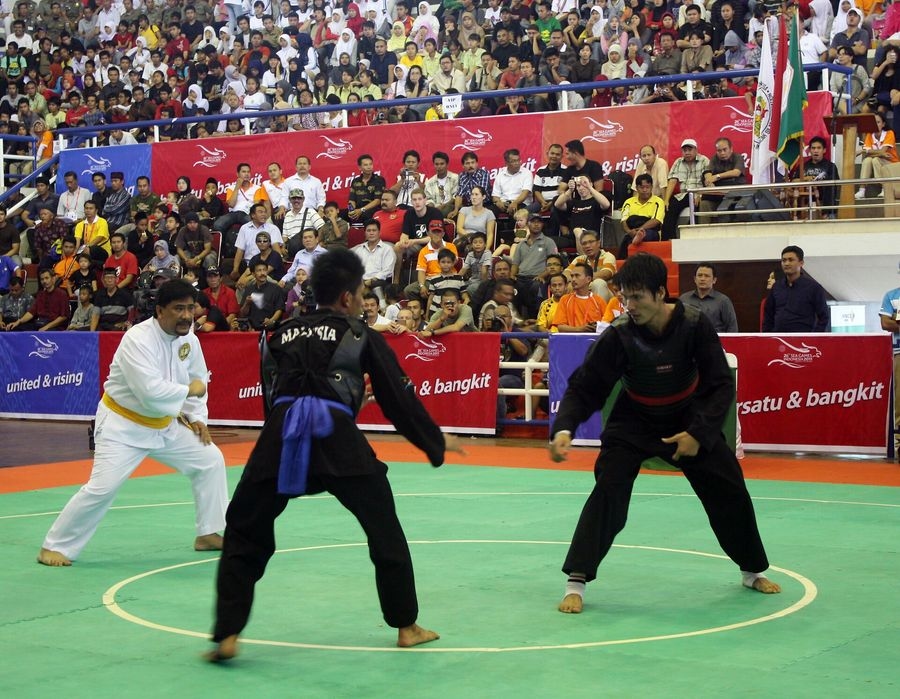
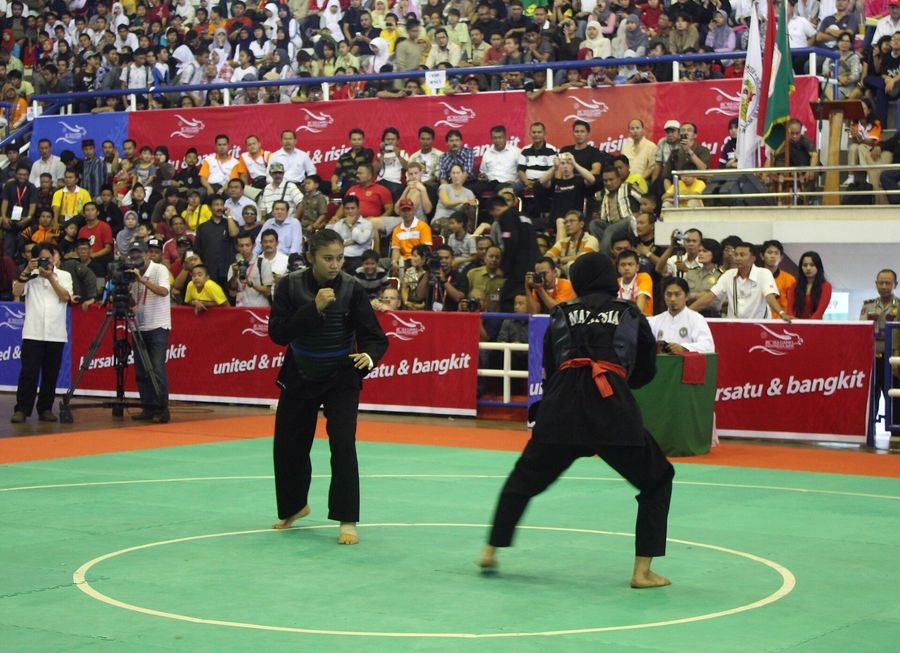
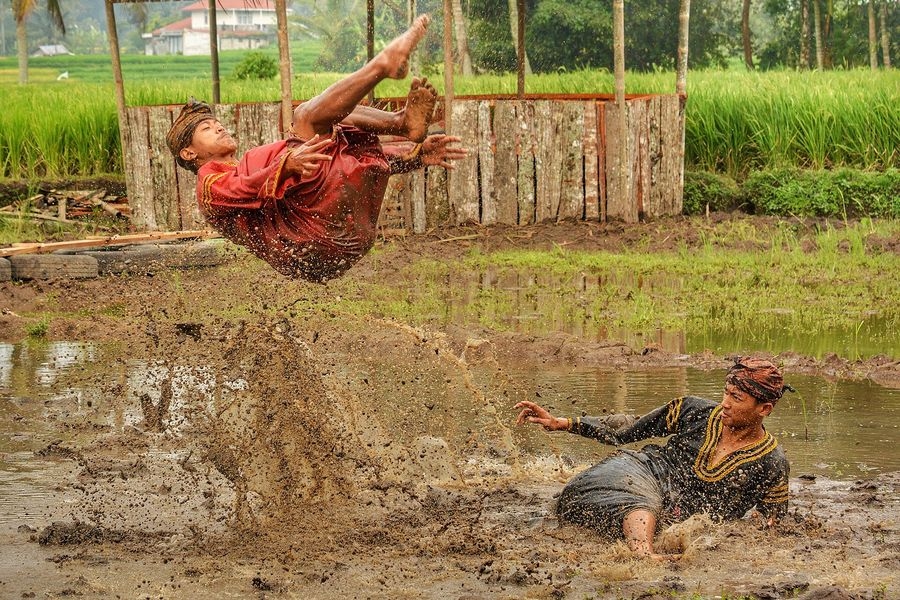
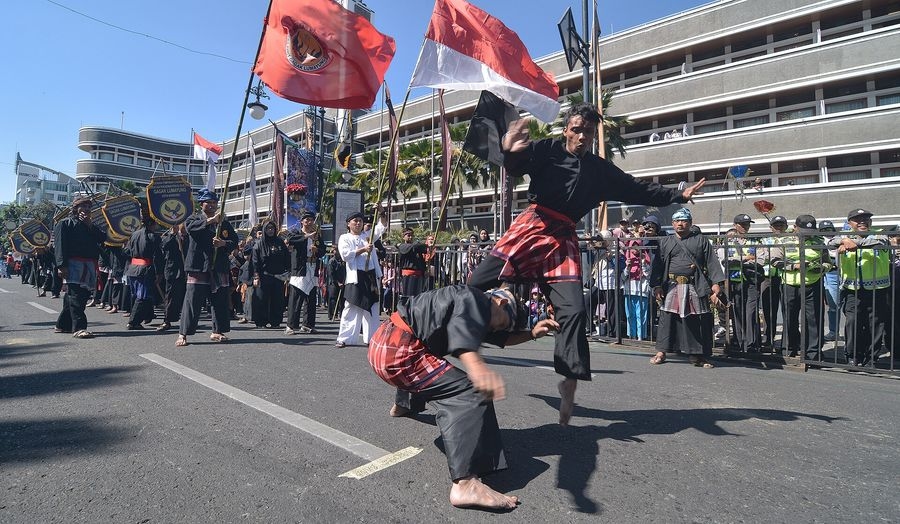
Photos from the Sport-Fight.net archives, credits being checked.
Videos
Frequently asked questions
Where can I train in pencak silat?
Look for clubs affiliated to your national federation or to a recognised Indonesian or Malaysian school. In France, pencak silat comes under the FFKDA, which lists its affiliated clubs. Clubs are thin on the ground in most of Europe, so search by town.
Is pencak silat effective for self-defence?
It was built for real fighting: defence against weapons, takedowns and strikes to vulnerable targets. How effective it is depends mostly on the teaching. A club that spars and drills under pressure will prepare you better than one focused only on jurus and display.
What is the difference between pencak silat and kali (arnis)?
Both come from South-East Asia and introduce weapons early. Filipino arnis starts with the stick and carries its angles over to the knife and empty hands. Pencak silat puts more weight on low stances, sweeps and takedowns, and is often linked to music.
What age can you start?
Competitions run children's categories with shorter rounds. Clubs often take children from around 6 to 8, without edged weapons or hard contact. Adults can start at any age, as long as they are ready for demanding leg work.
What is the link between pencak silat and The Raid?
The Raid (2011), directed by Welshman Gareth Evans, was shot in Indonesia with Iko Uwais in the lead. The fights, choreographed by Iko Uwais and Yayan Ruhian, are based on pencak silat. Both had already worked with Evans on Merantau (2009).
Is pencak silat an Olympic sport?
No. It has been part of the Southeast Asian Games since 1987 and joined the Asian Games in 2018, but it is not on the Olympic programme.
On screen
The Raid (2011)
Gareth Evans
Pencak silat clubs
Cities with the most clubs:
- Saint-Paul (974)4 clubs
- Paris (75)3 clubs
- Saint-Denis (974)3 clubs
- Montpellier (34)2 clubs
- Maisons-Laffitte (78)2 clubs
- Hyères (83)2 clubs
- La Chapelle-Palluau (85)2 clubs
- Le Tampon (974)2 clubs
- Nouméa (988)2 clubs